Skip to content
The Bonsai Art

Workshop道具

Tools of the trade

What we actually use on our workbench: just enough to get started, nothing you don't need.

Before you buy

What to check on each purchase and what can wait.

Work out how much soil you need →

Tools

  • Bonsai tool roll with concave cutters, shears, tweezers and a rake
    Photo: Ragesoss / Wikimedia Commons · CC BY-SA 3.0
    Tools

    Carbon steel concave cutter · 205 mm

    Its curved blades cut the branch flush with the trunk. If you buy just one tool, make it this one.

    For
    Branches up to 12 mm
    Level
    All
  • Case with bonsai tools
    Photo: Edward Cwik / Wikimedia Commons · CC BY-SA 3.0
    Tools

    Starter tool kit

    Concave cutter, scissors, wire cutter, tweezers and rake in a case. Cheaper than buying the pieces one by one when you start.

    Includes
    5 tools + case
    Level
    Beginner
  • Bonsai shears, concave cutter and root cutter on wood
    Photo: Cindy Shebley / Flickr · CC BY 2.0
    Tools

    Steel root cutter · 200 mm

    Cuts thick roots and stumps when repotting without straining your concave cutter, which soil quickly blunts.

    For
    Thick roots and branches
    Use
    Repotting
  • Close-up of serrated-tip metal tweezers
    Photo: Joachim Schnürle / Unsplash · Unsplash License
    Tools

    Tweezers with repotting spatula

    Tweezers for plucking needles and removing dead leaves; the spatula end smooths the soil and places moss.

    Length
    ~200 mm
    Use
    Plucking, moss, cleaning
  • Bonsai root rakes and root hook with wooden handles
    Photo: Cindy Shebley / Flickr · CC BY 2.0
    Tools

    Three-prong root rake

    Combs the root ball from the outside in without tearing fine roots. Essential on repotting day.
    Prongs
    3
    Use
    Repotting

Soil

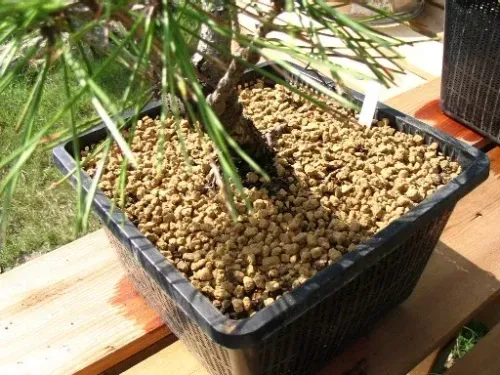
  • Dry akadama granules in a training pot with a pine
    Photo: Globalist1789 / Wikimedia Commons · Public domain
    Soil

    Hard-grade akadama · 2–5 mm

    The base of nearly all our mixes: it holds water without waterlogging and changes colour as it dries.

    Grain
    3–6 mm
    Mix
    50–70 % with pumice
  • Kanuma grains next to a ruler
    Photo: KENPEI / Wikimedia Commons · CC BY-SA 3.0
    Soil

    Hard-grade kanuma · 2–5 mm

    Acidic Japanese substrate for azaleas and other acid lovers. Without it, satsukis turn yellow.

    pH
    Acidic
    For
    Azaleas, rhododendrons
  • Red and black volcanic rock
    Photo: Pedro Vit / Unsplash · Unsplash License
    Soil

    Lava rock · 3–8 mm

    Adds structure and air to mixes for pines, junipers and olives. It does not break down over the years.

    Grain
    3–8 mm
    For
    Conifers and Mediterranean species
  • Soil

    Pumice · 3–6 mm

    Light, porous and stable: it brings drainage and air to the mix. The second base of nearly all our soils.

    Grain3–6 mm · Mix20–50 %

Feeding

  • Organic fertilizer pellets
    Photo: RolfSr / Wikimedia Commons · CC BY-SA 4.0
    Feeding

    Solid organic bonsai fertilizer

    It releases nutrients slowly with every watering, so it is hard to overdo. Ideal for beginners.

    Format
    Pellets
    Frequency
    Every 4–6 weeks
  • Iron chlorosis (yellow leaves) on a young rose
    Photo: Natalka Ukraine / Wikimedia Commons · CC BY 4.0
    Feeding

    Iron chelate (EDDHA)

    Corrects chlorosis (yellow leaves with green veins) in azaleas and species that suffer with hard water.

    For
    Iron chlorosis
    Use
    Dissolved in water
  • Feeding

    Amino acid biostimulant

    A liquid for the watering can with free amino acids and some organic nitrogen. A supplement for recovery after repotting or stress; it does not replace fertilizer.

    Contents8.9% amino acids · 7.2% N · 2.4% P · UseDiluted in water

Wiring

  • Ginkgo trunk wired in a spiral
    Photo: Tangopaso / Wikimedia Commons · Public domain
    Wiring

    Anodized aluminium wire · several gauges

    Soft and easy to remove. A 1 to 4 mm set covers nearly every branch of a young tree.

    Gauges
    1 · 1.5 · 2 · 3 · 4 mm
    Use
    Deciduous and conifers
  • Coil of copper bonsai wire
    Photo: Hinnerk11 / Wikimedia Commons · CC BY-SA 4.0
    Wiring

    Annealed copper wire

    Holds more with less thickness than aluminium. The classic for pines and junipers, though it takes a little more practice.

    Gauges
    1–4 mm
    Use
    Conifers

Watering

  • Woman misting the leaves of a potted plant
    Photo: Vitaly Gariev / Unsplash · Unsplash License
    Watering

    Brass mister with fine nozzle

    Humidity for tropicals while they overwinter indoors, when central heating dries the air.

    Capacity
    500 ml
    Use
    Tropicals in winter
  • Copper bonsai watering can
    Photo: Tangopaso / Wikimedia Commons · Public domain
    Watering

    Watering can with fine rose

    A fine shower soaks the soil without washing it away or lifting the moss.

    Capacity
    1–2 L
    Use
    Daily watering
  • Watering

    Humidity tray with gravel

    Raises humidity around tropicals while they overwinter indoors, without waterlogging the pot.

    ForTropicals in winter · UseWith gravel and water

Pots

  • Several ceramic bonsai pots
    Photo: Ragesoss / Wikimedia Commons · CC BY-SA 3.0
    Pots

    Ceramic bonsai pot · unglazed stoneware

    High-fired stoneware, frost resistant, with drainage and tie-down holes. Earthy tones suit conifers and deciduous trees.

    Material
    Stoneware
    For
    Display
  • Bonsai in a black glazed pot on a wooden table
    Photo: Erik Mclean / Unsplash · Unsplash License
    Pots

    Glazed oval pot

    A blue, green or cream glaze sets off flowers and fruit. Ideal for azaleas, pomegranates and maples in autumn.

    Shape
    Oval
    For
    Flowering and deciduous
  • Bonsai pots with mesh over the drainage holes
    Photo: Ragesoss / Wikimedia Commons · CC BY-SA 3.0
    Pots

    Training pot with mesh base

    Sturdy plastic with a mesh base: airy roots and fast growth while the tree develops.

    Material
    Plastic
    For
    Developing trees

Care

  • Green aphid on a leaf, one of the pests insecticidal soap controls
    Photo: Viktor Forgacs / Unsplash · Unsplash License
    Care

    Concentrated insecticidal soap

    Our first resort against aphids, mealybugs and whitefly: effective and gentle on the tree.

    Against
    Aphids, mealybugs, whitefly
    Use
    Sprayed in the evening
  • Care

    Cut paste for pruning wounds

    Seals large cuts so the edges do not dry out and the wound closes more cleanly.

    ForCuts over 5 mm · UseAfter pruning

  • Care

    Bonsai turntable

    Turning the tree without touching it changes how you work: you see every side while pruning or wiring.

    UsePruning and wiring · LevelIntermediate